
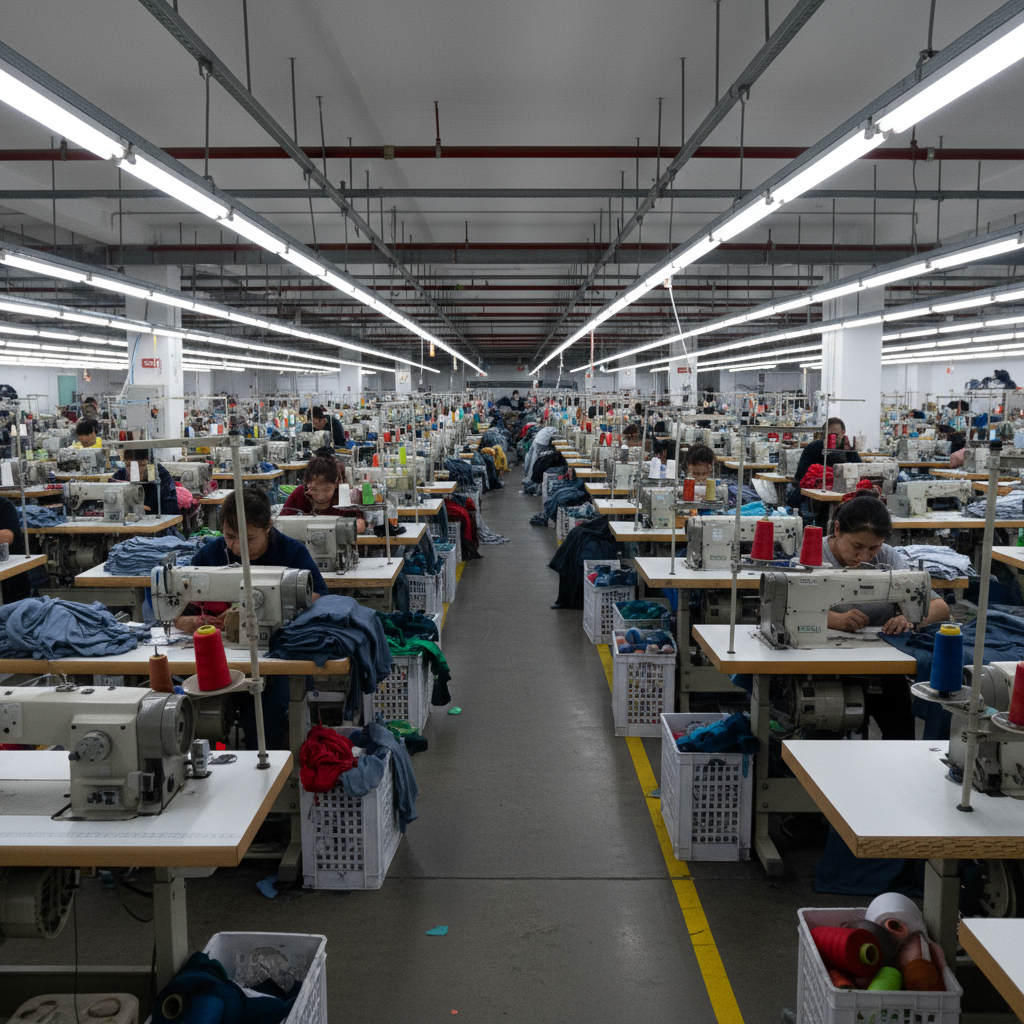
Every stitch tracked.
Every window met.
Twelve thousand units per shift, from spreading table to shipping dock — with the production transparency your current manufacturer still hasn't figured out.
Production Floor · Zone by Zone
The gap your current manufacturer doesn't want you to measure.
Every number below is auditable. Pull your last three production reports and run the comparison yourself.
Fewer defects than the industry average — meaning less rework, fewer chargebacks, and no 11pm calls to your QC team.
Average CMT cycle. Not the optimistic quote — the actual calendar average across all order types in Q4 2025.
Minimum order. Enough to test a new silhouette without committing a season's worth of budget to a factory that may miss spec.
Communication Infrastructure
Visibility is not a feature. It's the baseline.
A factory that won't show you its production floor in real time is a factory with something to hide. Here's how we're built differently.
Live Production Dashboard
Log in from any timezone. See units cut, units sewn, units at QC, and units packed — updated every 90 minutes, not every week.
Dedicated Account Manager
One person who knows your tech pack, your tolerance stack, and your shipping window — not a shared inbox with a 48-hour SLA.
Inline QC — Not End-of-Line
Spec deviations caught at the cutting stage cost nothing to fix. Caught after 4,000 units are sewn, they cost your entire margin.
Total Cost of Production
Price per unit is the wrong number to negotiate.
The factory that quotes $0.40 less per unit and ships 14 days late will cost you more than the factory that quotes full rate and delivers to spec. Here's the math.
At industry-average defect rates, a 5,000-unit order generates ~92 defective garments. At $200 landed cost each, that's $18,400 in rework, replacement, or chargeback exposure — before you factor in the freight delay.
A single late delivery to a major wholesale account typically triggers markdown allowances of 15–25% on the affected SKUs. On a $200k order, that's $30–50k off your invoice — plus the relationship cost.
When a manufacturer misses spec or goes dark, you're not just losing production time — you're restarting the sampling clock. New tech pack, new grading, new fit session. That's a full season, gone.
What did your last missed delivery window actually cost you?
Most sourcing managers have never run this number. The production audit surfaces it — then shows you the delta if the same order ran through Loom's floor.
Start Here
Your Production Audit.
Three questions, one week turnaround.
We review your current production profile — volume, category, lead time — and return a side-by-side cost-of-production analysis showing what your current setup is actually costing you versus what a Loom production run would look like.
Line-by-line cost-of-failure breakdown for your last order
Loom capacity match — floor availability for your volume and timeline
Fabric sourcing options within your spec and budget
Sample production pathway and timeline to first delivery